By Colette O’Connell, PRO of the Irish Beekeepers’ Association CLG
Those beekeepers here in Ireland who are interested in preserving and protecting the native black bee Apis m. mellifera, for future generations are only too aware of the ever-increasing pressures on this bee. We are seeing the ever increasing pressures on existing pollinators, as well as our honey bees.
Asian Hornet, Vespa velutina, becoming established here in Ireland, may be the final nail in the coffin for native pollinators and honey bees on the island of Ireland. Beekeepers of course are primarily worried about the impact of Vespa velutina on honey bees but there are wider implications, on pollinating insects, crop yields, harvests such as the grape harvest, and downstream effects on the economy and on the wider public.
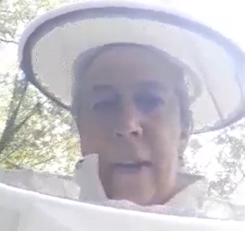
Colette in apiary in Galicia, Spain.
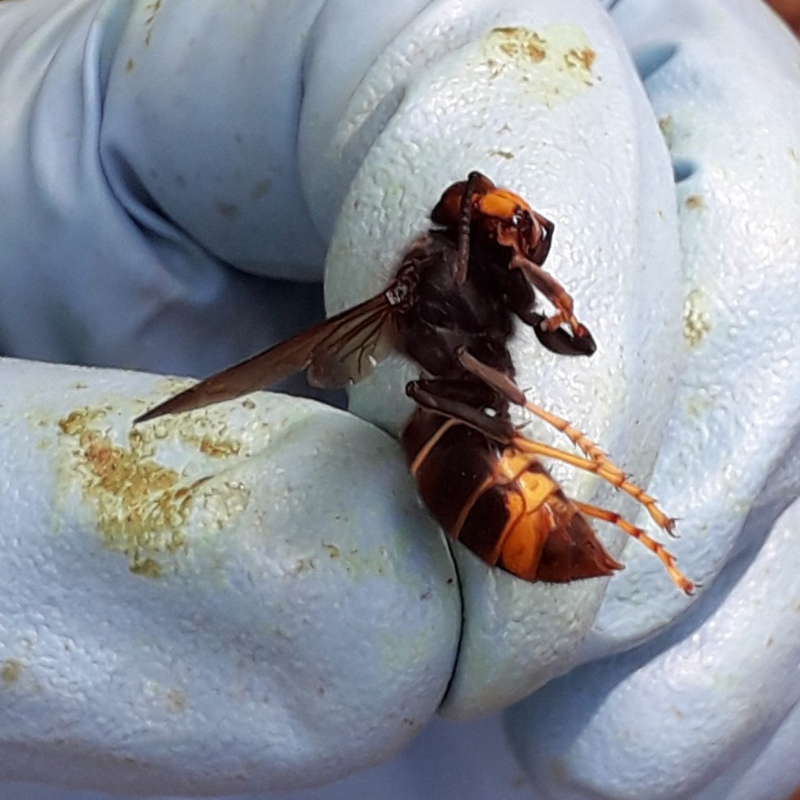
Photo shows an Asian Hornet being held by Colette
In October 2022, I was one of two Irish Beekeepers invited by the Atlantic Positive Project team to make a two-day study visit to Galicia to learn of the importance of ensuring that Asian Hornet does not become established here in Ireland. Half of day one was spent in discussion with participants in the Atlantic positive project, the remaining time, visiting apiaries and seeing Velutina in action and witness its effect on honey bee colonies.
The Atlantic Positive Project
The Atlantic Positive project (2.3 million euro) which recently concluded was coordinated by the Centro de Estudos Eurorrexionais Galicia and North Portugal ( CEER ). This project had among its activities control of the invasive Asian Hornet Vespa velutina. There were 10 institutions and about 20 other organizations from 5 countries, in three of which (ESP, POR, FRA) the hornet has become established and in two (GB, IRE) not so far. The project aimed to coordinate previous university collaborations within an international consortium that includes stakeholders, public administrations and researchers.

There are four broad strands to research on V. velutiuna
- The diet of V. velutina, its annual lifecycle and its relationship with meteorological and environmental conditions.
- Impacts of V. velutina on pollination; improved methods of control and detection of nests using radio telemetry systems to radio track it to its nests and traps with specific baits.
- Environmental and biological factors that determine its population dynamics and spread. Targeted methods to minimize the population of V. velutina with minimal ecological impact on native populations.
- Biological control: using parasites from its native environment in Asia; molecular analysis of parasites that may affect this invasive species and mechanisms for its distribution.
Threat posed by the Asian Hornet
Wherever the hornet becomes established, huge costs are involved for beekeepers attempting to protect their colonies. It is not unusual for beekeeper to spend 20 to 30% of their income from honey on anti-hornet strategies to protect their bees. And like wasps, hornets do not only prey on bees; in Galicia, hornets also feed on the grapes often ruining the entire harvest locally. Beekeepers are forced to find and destroy nests, and use a variety of traps to defend hives. No intervention is without cost and beekeepers may be forced to move their colonies if the hornets learn to avoid traps. So both beekeepers and local authorities suffer losses and in many locations there is an acceptance that the hornet is there to stay with no hope of its eradication. In such areas many beekeepers have given up and no longer are involved in apiculture. (30% of hives die out due to the activity of Asian hornets and the reduction of honey bee activity means less honey.)
Atlantic Positive in a survey of 400 beekeepers in France, Spain and Portugal, (2020) found that just under €8 million was spent by them to protect their honey bees since the arrival of the Asian Hornet.
Local authorities spending on removal of nests: €2 million in Galica removal of just under 23,000 nests /year; €11,200,000 in France, €8, 000,000 in Italy.
Costs for public health, hospital admissions etc and public fear are more difficult to quantify.
Environmental costs eg pollination reduction etc, are hight.
We also learned that some beekeepers are using a “Trojan horse” method in the battle against Velutina. This is when individual hornets are trapped and infected with a pesticide before being released. It is hoped that it will bring the pesticide back to it’s nest and this will kill off the population of hornets in the nest. As this is not guaranteed and there is no way of controlling the effect of this pesticide in the environment nor the wider effects, it is not promoted by the researchers and beekeepers with whom we met in Galicia.
Bees’ Response to being hunted by Velutina
A first line of defence is to reduce the size of the entrance so that hornets cannot gain access to the colony. While this may be partly successful it does not deter the hornet nor encourage them to leave the area as they still attack foraging bees.
Bees mount a response to attack by hornets. The hornet “hawks” in front of the hive and the bees initially dart in and out of the hive attempting to avoid them. However, as the number and attacks increase, the honey bees switch to defensive behaviour. They cluster at the entrance of the hive as a defence mechanism and they stop flying.
This leads to reduced foraging by individual bees and together with loss of workers, the strength of the colony declines to the stage that most bees withdraw inside the hive. This allows the hornets to enter and take brood and bees and eventually stores.
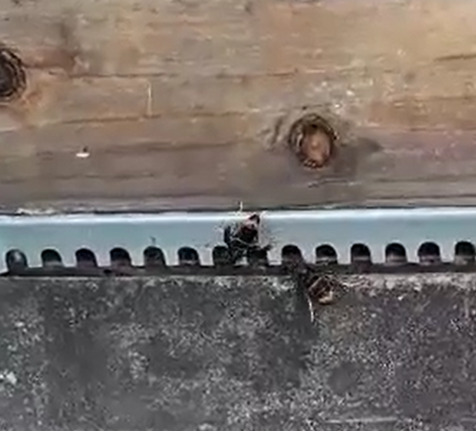
Hornets attempting to enter a hive with a reduced entrance
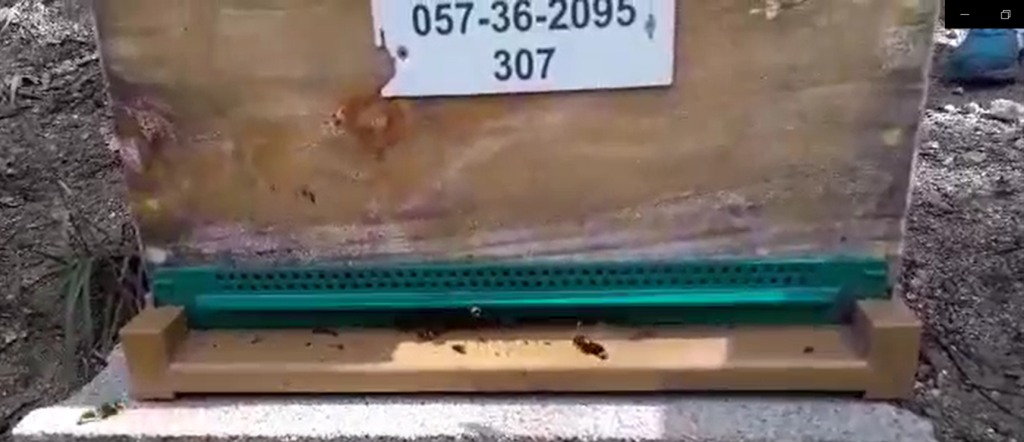
Honey bees acting defensively and have clustered at the entrance of the hive.
Beekeepers’ response
Many forms of baited traps are not recommended because they mostly trap useful pollinators and because of this they need to be sited carefully and indeed hornets may learn to avoid them. Jersey Action Group members have adapted their sentinel traps to allow beneficial pollinators to escape, and shared the adaptations with the IBA CLG and these have been passed on to DAFM.
We observed the use of the deterrent of choice i.e. the electric harp. This is essentially a screen consisting of frame supporting a series of parallel wires, 1.8 cm apart. This separation allows bees to pass though without touching two adjacent wires. Bees are too small to bridge the gap. Alternate wires are attached to opposite poles of a battery (6V or 12V) and thus the mesh is electrified and insects completing the circuit between two wires are electrocuted. Sometimes harps are deployed in front of hive like a porch, in other cases the harp is placed to intercept hornets patrolling between colonies. Overall electric harps are the most successfully used protection, but are not fail-proof as we witnessed the hornets successfully avoiding them. Also, a hornet body trapped between the wires, and a rain fall will cause the Electric harp to short circuit, and cease working.

Two electric harps in position at right angles to the landing boards
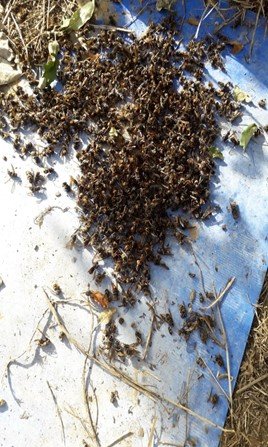
Hornets killed by the electric harps
The frustration of watching the bees succumb to the incessant hawking and hunting of V. velutina, is relieved somewhat by “swatting” and killing occasional ones. This was experienced and observed at our last apiary visit.
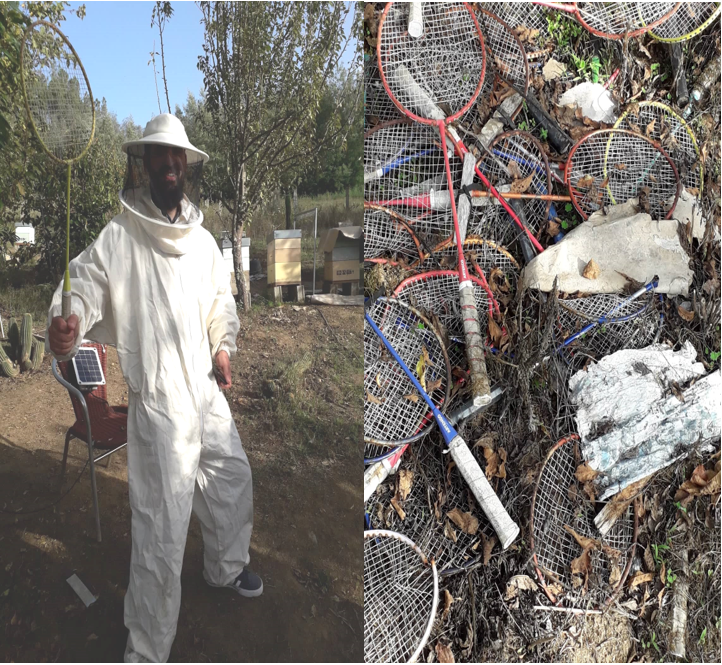
Racquets are great to alleviate beekeepers’ frustration against the hornet!
Lessons for Ireland
To date, and to our knowledge, we remain free of this apex predator. However, the knowledge and experience of beekeepers abroad urges us that Ireland must ensure that V. velutina not be allowed to become established here. If it should do so, we will NOT be able to eradicate it.
The public has an important role to play; if a member spots an AH and contacts the alert phoneline, it may prevent an individual AH queen from establishing here as happened in France. (In 2004, ONE fertilised Asian Hornet Queen arrived in the port of Bordeaux, in a consignment of Chinese pottery. Genetic analysis has confirmed that that ONE QUEEN, is responsible for the spawning of all of western Europe.)
The action of one member of the public, in Dublin, to the finding of one AH queen that arrived here, prevented that insect from setting up a nest etc here.
In May of 2023, the local government in Cherbourg area of FRANCE, confirmed the presence of just under 10,000 Asian Hornet nests. Ireland has four weekly summer ferry crossings with Cherbourg. We can definitely expect to see the arrival of some opportunistic AH Queens, piggy backing on human transport. We know from European experiences that it very good at doing this, showing up in locations where it has not been noted previously. (Truck depots etc)
Beekeepers will probably be the first to detect the presence of a nest with numbers of the hornet attracted to apiaries for a plentiful supply of food, honey bees, and so we propose that beekeeping groups around the country be formed into Asian Hornet action groups, primed to act appropriately when an Asian Hornet is recorded. The awareness that this has created has worked successfully in the GB and Jersey. Existing networks such as the IBA and NIHBS, FIBKA and the UBKA could be used for networking for this purpose. An existing network such as the NIHBS Queen Rearing groups is an example that could act as an alert and ensure a prompt and swift reaction to a positive sighting, working hand in hand with the department and NPWS.
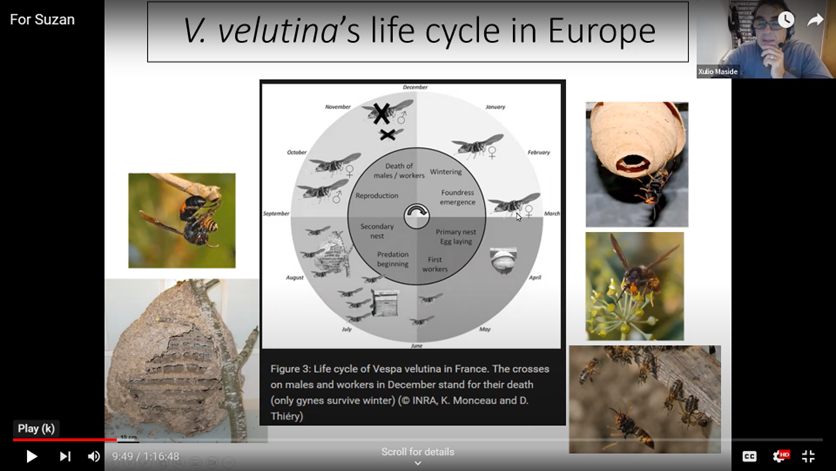
There is need for a clear and definite plan to be activated when a positive sighting is confirmed. This should involve a trapping and tracking plan, to ensure successful nest location and removal. The National Park and Wildlife service, with responsibility for the removal of nests, should be adequately equipped with hornet-protective suits, and given practical experience in tracking. Knowledge and experience of Dr. Kennedy and the Jersey Action Group has been offered to beekeepers here in Ireland and we should avail of this so that we can act appropriately when required to do so. With the assistance of DAFM officials and the Government, and local authorities, beekeeping associations and all concerned parties, should immediately embark on a public awareness campaign amongst their members and the public. This would also prevent misidentification of harmless hornets and false alarms. Such a campaign will help to ensure that when fertilised queen Asian hornets arrive here, and it is only a matter of time until they do, they may be more quickly and correctly identified, and consequently, may be prevented from establishing secondary nests and becoming established here, as they have elsewhere. (Secondary nest if allowed to develop through to autumn, will release several hundred foundresses in to the environment and these are the queens that will set up nests the following spring, and so the invasion starts!
Need for Action
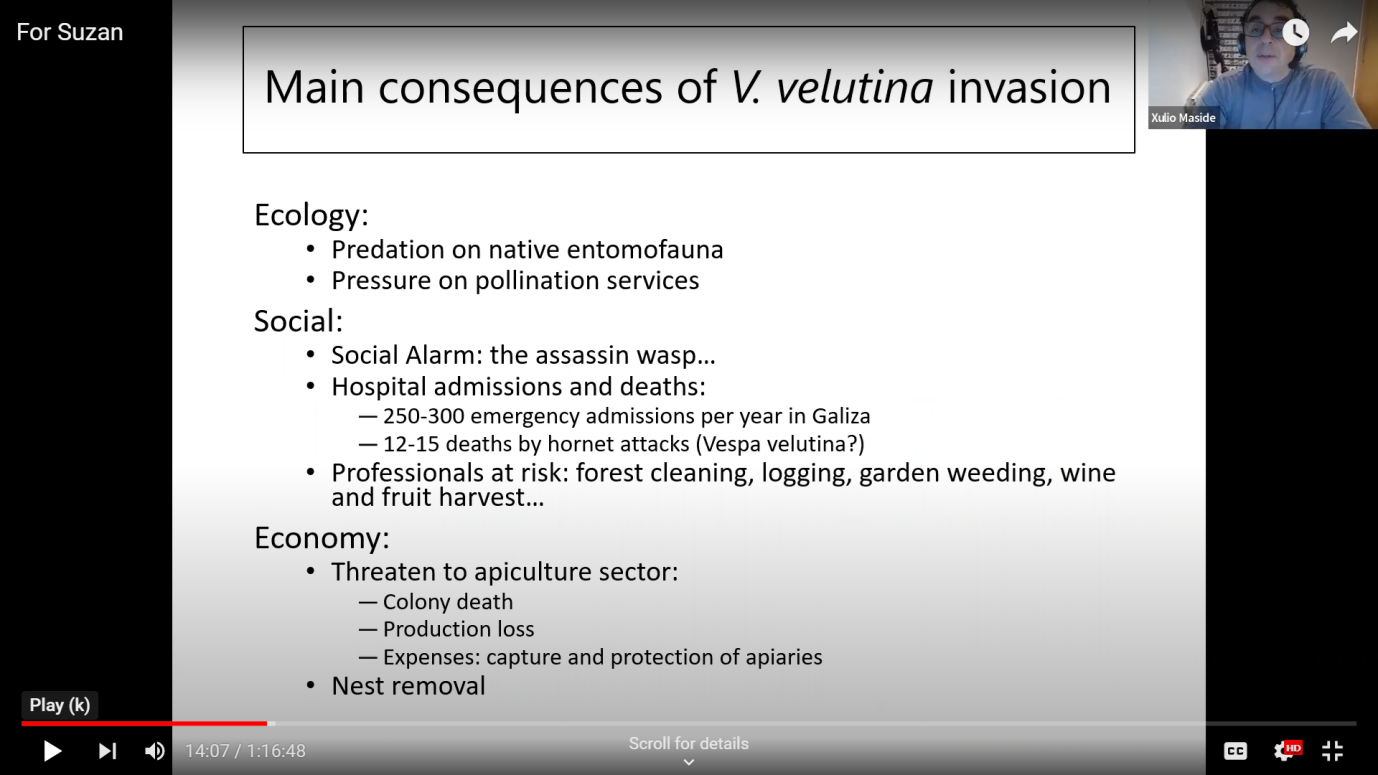
Beekeepers on the island of Ireland, are only too aware of the pressure that pollinating insects and honey bees face now. The arrival of the Asian Hornet to the island of Ireland, might be the ultimate final pressure on these beneficial insects, from which there is no recovery. Prof Maside in his webinar to the Irish beekeepers, tells us that only 30% of the flying population exist since the end of the last century.
We owe it to future generations to ensure we do what we can now, to protect our native biodiversity, our fruit and food crops, the public, as well as our native Irish honey bees. For this reason, the Irish Beekeepers’ Association CLG has been in contact to coordinate with other beekeeping organisations and the DAFM, to put such an alert network into being. Further information is available from pro@irishbeekeepersassociaiton.com
We are grateful to Prof Xulio Maside, University of Santiago and Co-ordinator of the Atlantic Positive Project for the Webinar he recently presented to Irish Beekeepers. This is available to view on the Atlantic Positive Project website and on the Irish Beekeepers’ Association CLG, Youtube channel, link here: https://www.youtube.com/watch?v=lNHDGrTPI0k
Invasion curve graph illustrates the importance of preventing the AH from becoming established here. (Courtesy of Prof. Xulio Maside, webinar link above.)

Ireland is at the prevention stage, and all with experience of Velutina, have advised that this is the most critical stage.
Prof. Xulio Maside advises that we must “be vigilant” and that “all effort must go into preventing Asian Hornet from setting up in Ireland.”
Galicia and other European countries with Velutina established, are at the “long-term management” stage, and will never be rid of the yellow legged hornet.
Other points to note.
Dr. Padriag Whelan, retired expert on alien species, has stated to me that if the Asian hornet comes and establishes here, we will never be rid of it.
John De Carteret, Jersey Action Group, who has been so helpful to us here in Ireland in alerting us and sharing information with us, told me that Velutina, loves beer. He recounted an incident, where a volunteer enjoying a beer swatted away a hornet which was on the rim of his beer can and thought nothing else. Taking a drink, with the same hornet in his mouth and promptly spat it out.
Luckily he was not stung. (Prof Maside in his webinar, advises us that the AH LOVES black beer too!)
Barbecues and meat will attract the insect. They are meat eaters and stomach contents have shown to contain hedgehogs etc.
Individual hornets are not a threat unless in cases such as above. However, if a member of the public gets too close to a nest, they will attack in numbers, sometimes with fatal consequences. Playgrounds, Tree cutting, Gardening etc Hard to see nests in green foliage.
Some of those assisting with nest removal in Jersey and wearing the protective suits have ceased with removals due to being stung through the suits.
Those with experience of Velutina, warn that when it comes, it will take over from the parasitic mite varroa destructor, which Irish beekeepers and beekeepers all over the world must now manage.
https://wildlifeinfrance.com/insects-france/asian-hornet-in-france
How the Baleraic managed up to recently.
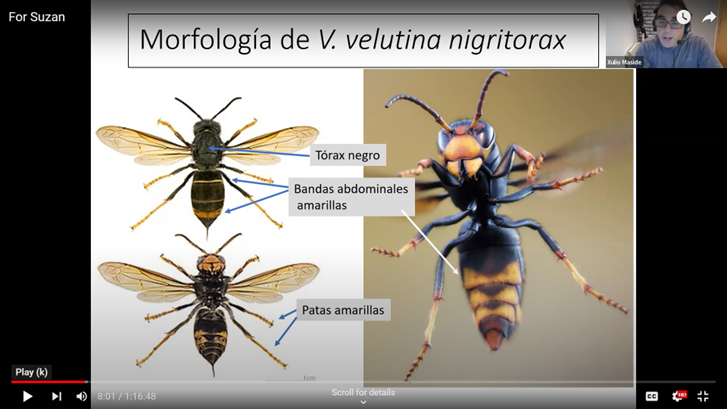
THE YELLOW LEGS OF THE ASIAN HORNET (yellow from the “knee” down,) ARE ONE OF ITS DISTINQUISHING FEATURES, HENCE THE NAME USED BY John De Carteret, of the Jersey Asian Hornet Group, THE YELLOW LEGGED HORNET
Recording of Webinar from Professor Xulio Maside, University of Santiago is available on the IBA You tube channel; to watch here click on link here.
https://www.youtube.com/watch?v=lNHDGrTPI0k
This insect MUST be kept out of IRELAND. Suspected sightings can be reported with a photograph through an online form, or the Biodiversity App; https://records.biodiversityireland.ie/record/invasives
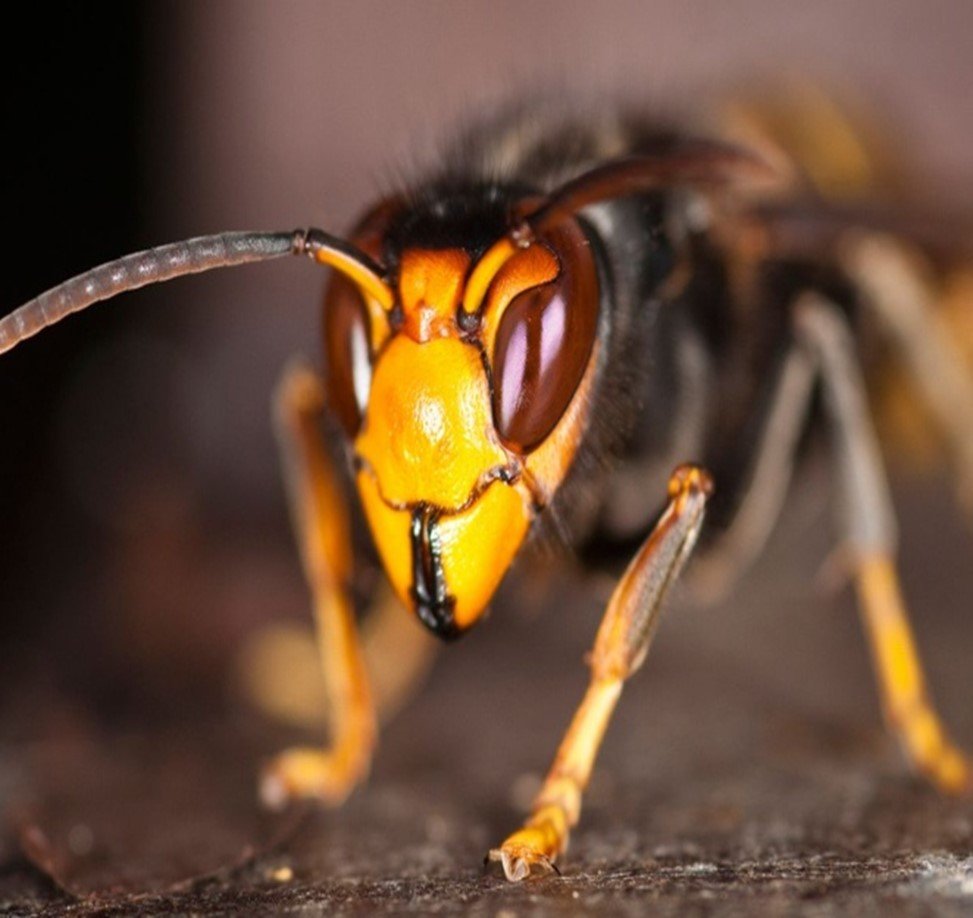
Photo courtesy of the BBKA, British Beekeepers’ Association.
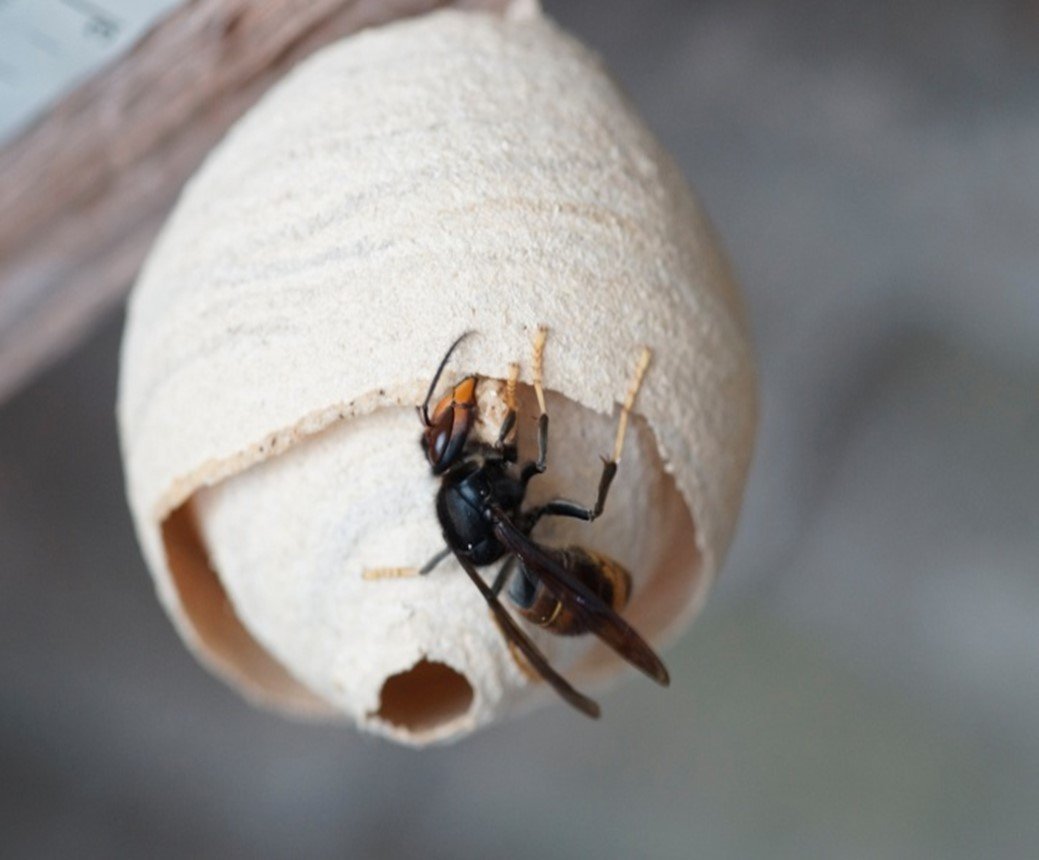
Photo courtesy of the BBKA, British Beekeepers’ Association.
Members of the public need to be on alert as these insects do attack if unsuspecting members of the public venture too close to their nests. Gardeners, tree surgeons and foresters are most at risk from attack as they work. Whilst Asian hornet appears to prefer high locations/trees etc for nest building, there are reports of nests being located at lower levels.
https://www.rte.ie/radio/radio1/clips/22227023/