
SWARMING: It’s how the bees populate!
May, June, July and August bring the busy time of year for beekeepers when we need to work with the bees and their instinct to swarm. Swarming is how bees make increases and populate. Beekeepers need to do regular colony inspections to ensure that their bees do not swarm. If this happens they lose the workforce of bees that will forage during the main nectar flow, from the blackberry and white clover, from which the main honey crop derives. Likewise, beekeepers serve the public by removing swarms before they take up residence in a roof or elsewhere where they can become a nuisance to the public or/and livestock.
August is when the honey crop is removed and he bees are treated for varroa mite. Honey is extracted and prepared for sale or home use depending on the bee keeper.
August and…
The start of another year and the cycle starts all over again…..
Each year during May and June, depending on the weather and conditions, bees will go into swarming mode. This is when the public really appreciates their local beekeepers.
Members of the public contact beekeepers when they come across a colony of bees which has taken up residence in a fallen tree or in an out building. Bees propagate by means of swarming and when the swarm issues, it will initially settle on a tree branch, or post, before eventually moving onto a new permanent home. Ideally the best time to capture a swarm is before it moves to it’s new permanent home, which can be in a chimney, or in a tree etc. and where the bees can become a nuisance to thc public or nearby residents.
Usually swarms will not harm people or livestock. Honeybees in a swarm have filled their stomachs with honey when leaving the parent colony. A full tummy, like with us, means they are more content. Also, a full tummy means that a bee will find it difficult to curve it’s abdomen to sting, As the colony does not yet have a home to defend it will not attack.
Occasionally a swarm will issue because of starvation, and these bees may be aggressive, due to hunger and impending death. For this reason, beekeepers advise that members of the public contact their nearest local beekeeper when they come across a swarm. It is important to remain calm, NOT to flap your arms or swat at bees if they do approach you, as this will attract further interest to you. Calmly walk away quietly and the bees will return to the colony, leaving you alone.
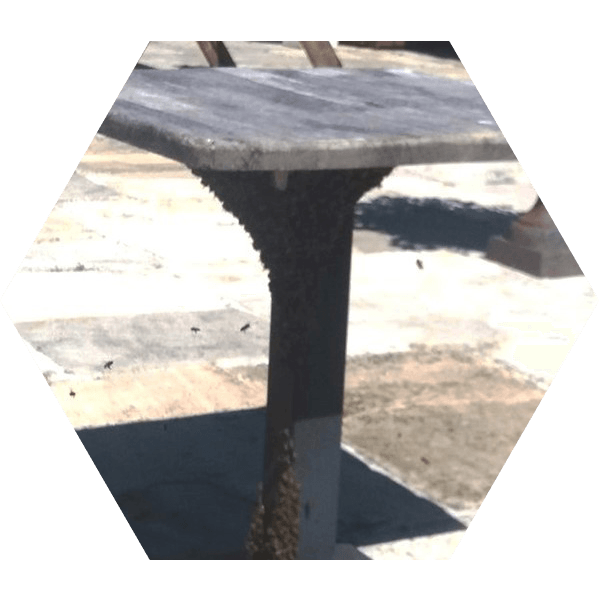
Swarm of honey bees settled under a Patio table in the Patio of Lawlors’ Hotel, Dungarvan, above.